The working class
Hisham Ashkar
1 May 2022
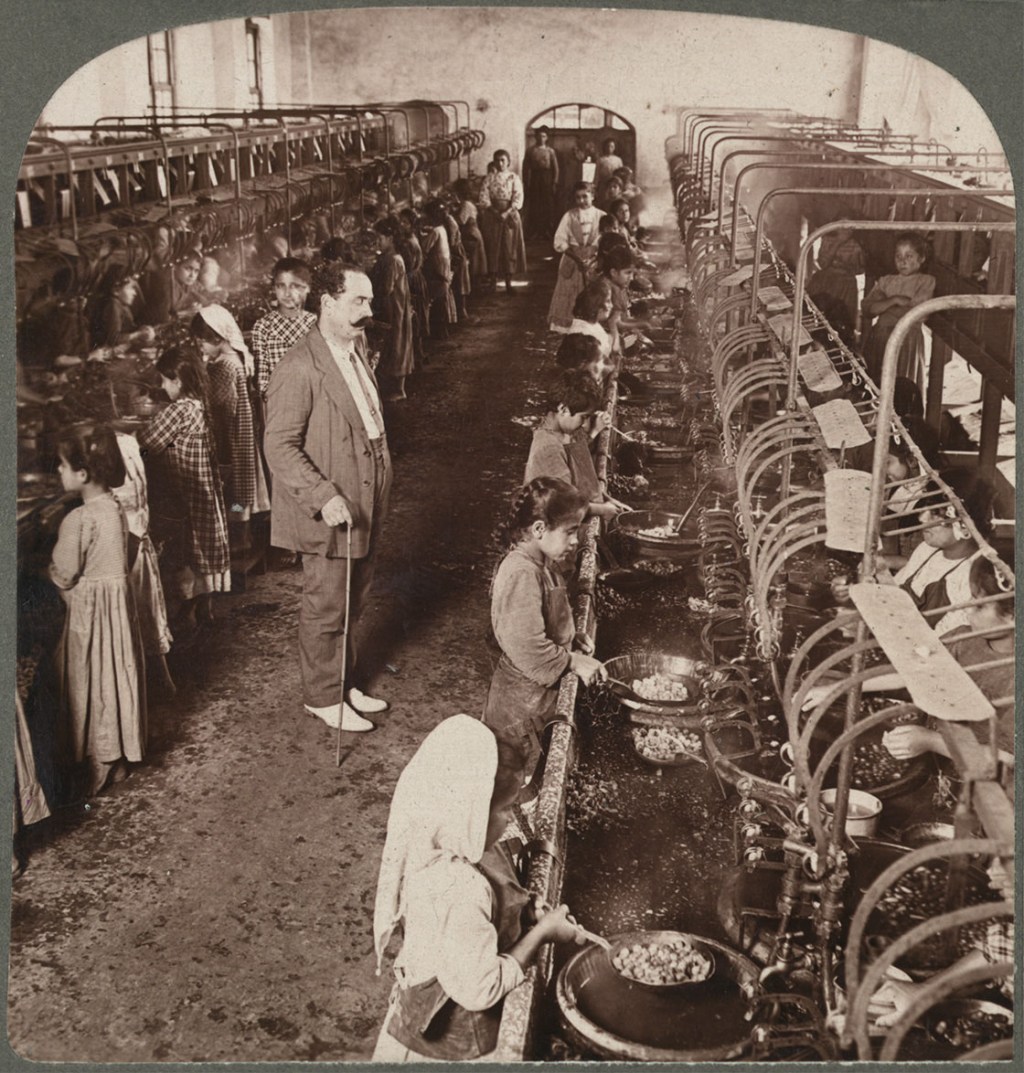
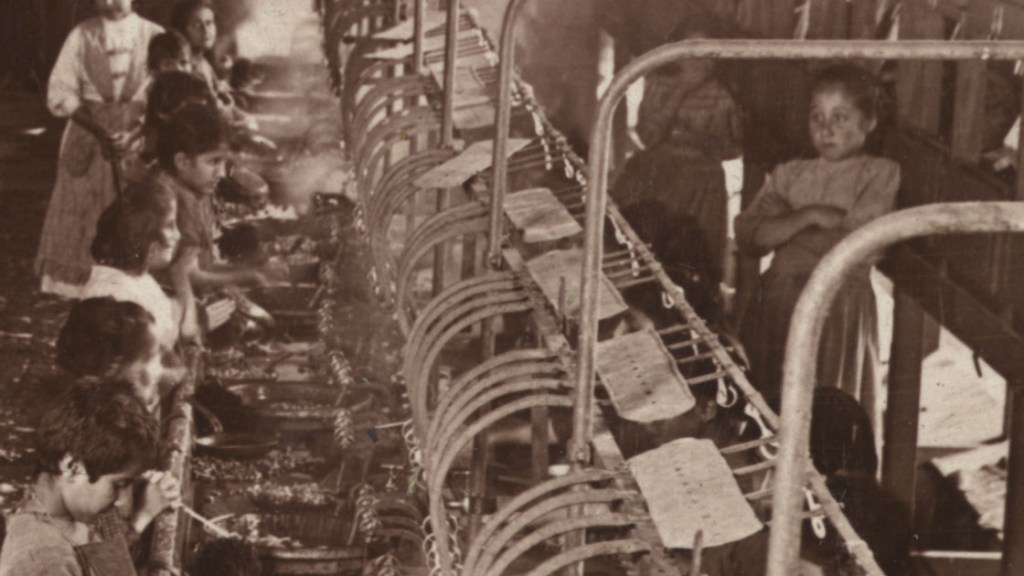
She’s no more than ten years old, I guess. Her back leans against the metallic beam of the silk reeling machine. Her arms are crossed. She’s looking straight at the man standing in the middle of the hall. This look in her eyes… is it fatigue? Is it fear? Many interpretations are in the air, but one thing is for sure. This look reflects a social power balance, a class relation. He’s probably the mill owner, and she’s just a silk worker.
The year is 1910 or 1911. The location is somewhere in Mount Lebanon, the birthplace —along with Egypt— of the industrial revolution in the Middle East back in the Nineteenth Century. The context is the interior of a silk factory, the backbone of that industrial revolution: a building filled with tiny bodies and tiny hands, washing, sorting, and boiling cocoons. A couple of overseers are at the back. And, of course, the owner, his white shoes, his fat belly, and his thin cane are trying to occupy the centre stage. After all, it is his capital, his factory, his silk, his achievement that the photo should capture. These tiny bodies aren’t but mere accessories, his accessories. Hence his orchestrated posture. But he’s trying and failing to be the central figure. Because reality always catches up to perturb and rearrange the pre-established order. It is on the side of the workers, enduring their daily routine and hardship —no acting, no posing for the camera. And reality converts the photo to be about them. It’s theirs, not his.
But who are they? What do we know about them? The answer is nearly nothing. Young working-class girls were not worth the wasted ink. But economic data on silk production and trade abounded. Influential writers of the time, such as Ameen Rihani —a son of a silk factory owner— were too busy idolising the silkworm. They had no space to spare for the social question of labour. Contemporary researchers are more concerned with workers’ religions and the moral codes of that period. Two misleading and irrelevant subjects. I’m not interested in debating and arguing why, simply because this space should be about factory girls. It is not about the plethora of academics who are too engaged in promoting and rehashing such clichés to the point that they’re oblivious to the contradictions contained within their writings.
We know almost nothing about them, but we do know a few things. We know that, at the turn of the century, the labour force in the silk industry was around 14,000 —the population of Mount Lebanon at the time was about 400,000. We know that approximately 12,000 were women. And we know that the vast majority of women workers were aged between 7 and 15 years old. We also know that men’s daily wages varied between 8 and 12 piasters, while women’s daily wages were between 1 and 6. A female apprentice’s daily wage was 1 to 2.5 piasters. And female apprentice workers are most of what we see in this photo. Pre-adolescent girls.
For capital, they were the ideal workers, cheap and controllable. They cost one-tenth of an adult male worker, and they can do the same job, even better. Their tiny figures can be squeezed easily into the entrails and the sides of the machine, therefore increasing productivity. And if they were smaller, no problem. They just made them stand on a low table, like the girl wearing a kerchief at the left of the photo. This white kerchief was what peasant men and women wore on their heads while working the fields (women tied the knot at the back, men at the front). These white kerchiefs in a factory show the transition from peasantry to factory workers.
As labourers, these young girls were versatile and productive. Plus, they were easy to control. It’s hard to imagine ten-year-old girls forming a trade union or going on strike. Any disturbance can be dealt with swiftly. A beating with a cane will suffice. Of course, the white-shoes man’s cane won’t be used for the beating. It was too expensive. He would only use it for poking. However, those who run the factory didn’t need to worry a lot. The girls were mainly disciplined by their parents. Another benefit of child labour is that capital can rely on patriarchy to control the workers. The parents sent their girls to the factory to gain an extra income. Their wages were grabbed by their parents. And to preserve this income, it’s their interest to keep their girls obedient.
These girls were subject to multiple systems of domination, industrial capitalism, and patriarchy, no doubt backed by gender and age discrimination. Many social groups benefitted from their labour, notably the merchants of Beirut and the religious institutions, some of which had their own silk factories. The silk industry and its exports brought immense financial profit. This wealth was mainly created by the labour of young girls, captured, to varying degrees, by nearly all segments of the society. A society-wide system of exploitation was at work.
The girls worked 10 hours a day in winter and 13 hours a day in summer. The workday usually started at around 4 or 5 in the morning. It ended around 7 or 8 in the evening, punctuated by three breaks. Missing the start of the shifts will lead to missing the day’s salary. The day was mostly spent standing in front of the basin, the work station, engulfed by hot and noxious steam, in a poorly ventilated building. The short break periods were spent in the court adjacent to the factory, where the dead larvae, and other waste, were left to decompose.
Moreover, these girls were not only forced into labour, robbed of the wealth they created, and left to work in a dire and unhealthy situation. But they were also stigmatized by a macho society. It all started with the Maronite church objecting not to child labour but to the mass mixing of boys and girls. It’s the same old story, the obsession of religious institutions and men, in general, with controlling female sexuality. And pretty soon, the silk factory, or kerkhaneh, became a synonym for brothel. Factory girls were depicted as whores. So we’re in front of a society exploiting girls’ labour while shaming them simultaneously.
The girls’ wages didn’t all go to their parents. At first, some managed to hide one or two piasters. And as they grew older and became conscious of their economic position and strength within their households, they were able to impose a different partition of their increasing salary. For most, investing in gold bracelets was a sure bet. Some went much further, accumulating enough money and assets. Reaching certain economic independence was their ticket to emancipation. So they packed their bags and left for the Americas and Australia in quest of a new life. At the turn of the century, nearly one-third of immigrants from Mount Lebanon were women. Most of them migrated as independent women, not as the wife of someone, or the daughter of another. A good number of these women were silk workers. It seemed the best way to fight this oppressive society was to leave it behind.
As for the girls in our photo, their future looked less hopeful. A couple of years after the photo was taken, the First World War broke out, and a man-made famine led to the death of half of Mount Lebanon’s population. To be accurate, the demise of half of the lower classes, including the factory girls. And if some of you are worried about the fate of the man in the white shoes, you can rest assured. He most probably not only survived the war and the famine but would have also increased his fortune during that period, similar to most of his bourgeois colleagues.
And today, more than a century later, what’s left of and about the factory girls? Nothing, but a couple of lines, generalities in some books, and a few photos without captions– nothing but the faces and postures of little girls, the ghosts of the first proletariat in the Middle East.
One must admire a society that builds its wealth through the exploitation of its little girls, and then brush this episode out of its history.
________
Since I’m not in the business of promoting texts that irritate me, I will only list one written source:
Labaki, Boutros. 1984. Introduction à l’histoire économique du Liban: soie et commerce extérieur en fin de période Ottomane (1840-1914). Beirut: Publications de l’Université Libanaise.

 parfois